
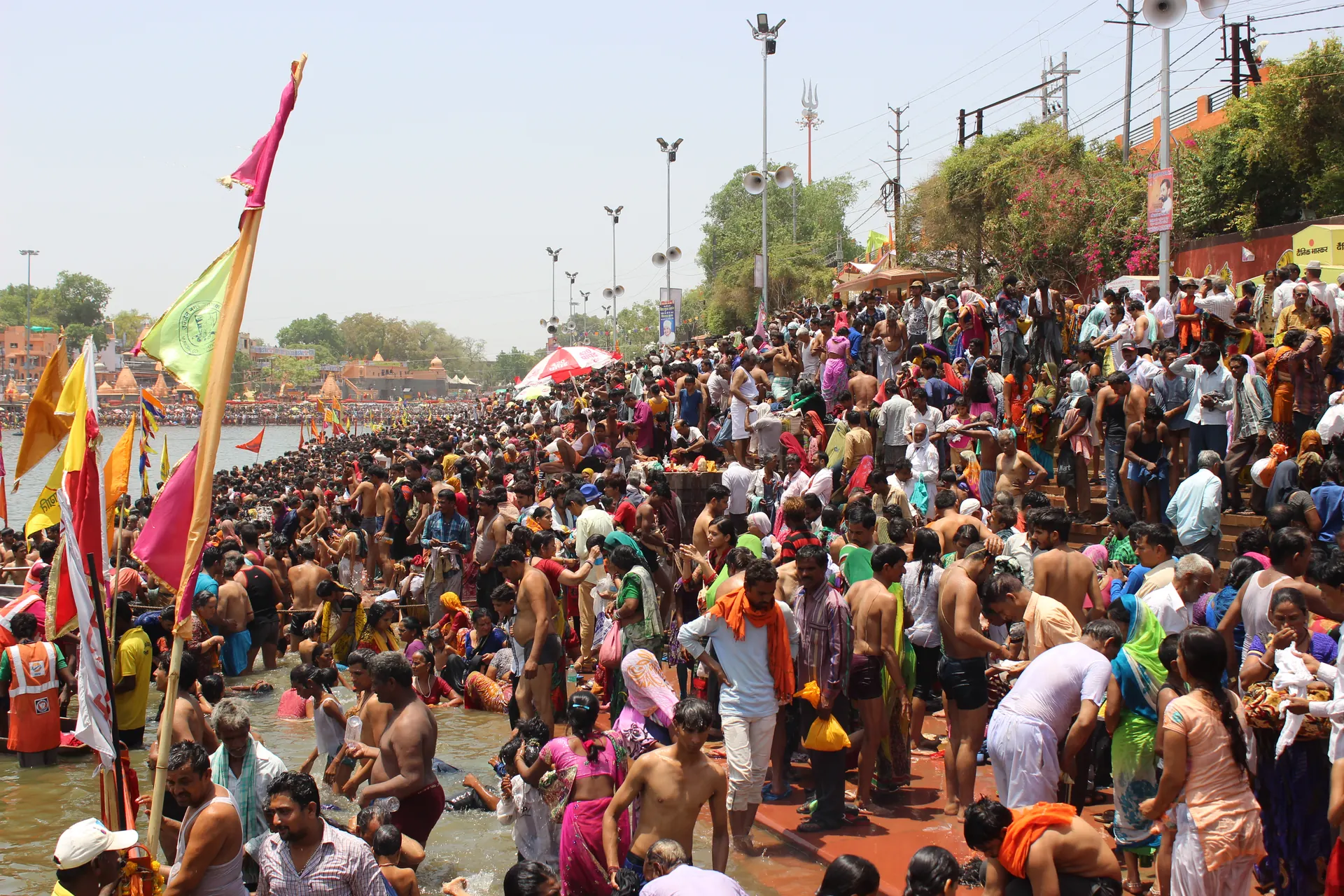
Ujjain's Kumbh · Shipra river
Simhastha 2028 Ujjain: 27 March – 27 May 2028
Once in about twelve years, Ujjain becomes the meeting place of India's ascetic orders. The Akharas set up camp along the Shipra, their processions wind down to the river, and pilgrims from every corner of the country come to bathe at dawn in the city of Mahakal. This is the Simhastha, Ujjain's Kumbh. In 2028 it runs from 27 March to 27 May.
Simhastha 2028 begins:
Shahi (Amrit) Snan
This guide brings together the full bathing calendar, the three Shahi (Amrit) Snan days, the Akharas and rituals to look for, how the mela grounds are organised, where to stay and how to stay safe. It follows the calendar published on simhastha.org.in. Final timings, the order of the Akharas and access arrangements will be announced by the Simhastha administration, so check them again before you travel.
Bathing calendar
Simhastha 2028 snan dates
11 bathing days, 27 March – 27 May 2028. The three Shahi (Amrit) Snan, when the Akharas lead the royal bath, are marked in gold.
- First Shahi Snan (Amrit Snan)
- Second Shahi Snan (Amrit Snan)
- Final Shahi Snan (Amrit Snan)
27Mar
Pratham Pavitra Snan
· Chaitra Shukla Pratipada
The opening sacred bath that begins the Simhastha.
4Apr
Chaitra Shukla Navami
An important day of worship and bathing in the Chaitra fortnight.
9Apr
Shahi Snan · Amrit Snan
First Shahi Snan (Amrit Snan)
· Chaitra Shukla Purnima
The Akharas and Naga Sadhus process to the river for the first royal bath.
14Apr
Vaishakha Krishna Panchami
· Vaishakha Krishna Panchami (at sunrise)
Bathing, prayer and pilgrimage early in the month of Vaishakha.
19Apr
Vaishakha Krishna Dashami
Religious observances and pilgrim bathing in the Shipra.
23Apr
Shahi Snan · Amrit Snan
Second Shahi Snan (Amrit Snan)
· Vaishakha Krishna Chaturdashi
The second royal bath led by the Akharas, expected to be the busiest day of the festival.
1May
Vaishakha Shukla Saptami
· Vaishakha Shukla Saptami (Ganga Saptami)
A day of river worship and sacred bathing.
5May
Vaishakha Shukla Ekadashi
· Vaishakha Shukla Ekadashi (Mohini Ekadashi)
Fasting, Vishnu worship and pilgrimage.
8May
Shahi Snan · Amrit Snan
Final Shahi Snan (Amrit Snan)
· Vaishakha Shukla Purnima
The concluding royal bath of the Akharas on the full moon of Vaishakha.
15May
Jyeshtha Krishna Saptami
Bathing and pilgrimage in the closing phase of the festival.
27May
Closing ceremonies — Purna Ahuti
· Jyeshtha Shukla Tritiya (at sunrise)
The final offering that brings the Simhastha to a close.
Significance
Jupiter in Leo, nectar on the Shipra
Why the Ujjain Kumbh is called the Simhastha, and how it took its present form.
The name explains the timing. Simha is Leo, and the Ujjain Kumbh is held when Jupiter is in Leo and the Sun is in Aries, an alignment that comes round about every twelve years. That is why the festival is called the Simhastha.
Ujjain is one of four Kumbh sites, along with Haridwar, Prayagraj and Nashik. According to the Puranic story of the churning of the ocean, drops of amrita, the nectar of immortality, fell at these four places. The Ujjain gathering has its own character, centred on the Shipra and on Shri Mahakaleshwar, the south-facing Jyotirlinga at the heart of the old city.
For a devotee, the central act is the holy dip in the Shipra, which is believed to wash away sin. Around it are darshan at Mahakal and the other great temples, discourses by saints, initiations into the Akharas, and community kitchens that feed visitors throughout the festival.
A short history
Bathing festivals on the Shipra are old, but historians trace the Simhastha in its present form to the eighteenth century. The Maratha ruler Ranoji Shinde invited ascetics from Nashik to a local festival at Ujjain, and over time the gathering took on the Kumbh tradition. This also explains why the Ujjain and Nashik melas fall within about a year of each other.
Under Maratha and later Scindia rule, the festival was managed with an eye on order among the ascetic groups. During the colonial period Ujjain was part of the Scindias' Gwalior State.
The previous Simhastha ran from 22 April to 21 May 2016, with Shahi Snan on 22 April, 9 May and 21 May. The 2028 festival is longer, at roughly two months, with three Shahi Snan in April and May.
Akharas & rituals
The thirteen Akharas and the rites of the mela
The thirteen recognised Akharas are the spiritual backbone of the Simhastha. These monastic orders set up camps on the mela grounds, keep their own daily discipline and lead the Shahi Snan in a set ceremonial order. Their Naga Sadhus are the most striking sight of the festival.
Shaiva (Sanyasi) Akharas
Orders of Shiva-worshipping sanyasis, including the Naga Sadhus. Juna is the largest of them.
- Juna
- Niranjani
- Mahanirvani
- Atal
- Anand
- Avahan
- Agni
Vaishnav (Bairagi) Akharas
Bairagi orders devoted to Vishnu in the Ramanandi tradition.
- Nirmohi Ani
- Digambar Ani
- Nirvani Ani
Udasin and Nirmal Akharas
The Udasin orders trace their lineage to Sri Chand. The Nirmal Akhara joins Sikh and Vedantic learning.
- Bada Udasin
- Naya Udasin
- Nirmal
Rituals and moments to witness
Shahi (Amrit) Snan
On the three royal bathing days the Akharas walk to the river in a fixed order with flags, insignia and chanting, and bathe before the public. Watch from behind the barricades and leave emergency lanes clear.
Peshwai processions
This is the ceremonial arrival of each Akhara in the city, with saints, Mahants, Naga Sadhus, music and decorated chariots. Routes and timings are announced by the administration and the Akharas.
Akhara camps and the dhuni
Visitors may enter authorised camps for darshan, satsang and blessings around the sacred fire (dhuni). Follow camp rules, and ask before you photograph a saint.
Shipra aarti
The evening aarti at Ram Ghat draws large crowds during the mela. Arrive well before sunset, and expect standing areas and entry to be controlled on busy days.
Mahakal darshan
Most pilgrims combine their bath with darshan at Shri Mahakaleshwar. Queue and booking arrangements may differ from normal during the festival, so check the temple committee's website.
Discourses and culture
Saints and organisations hold talks on dharma, bhakti, yoga and the scriptures, alongside devotional music, exhibitions and heritage programmes.
Where it happens
Ram Ghat and the bathing ghats
The royal baths centre on Ram Ghat, and many more ghats line the Shipra. The nearest ghat to you is often the calmest place to bathe.
Ram Ghat
The heart of the Simhastha and the ghat of the Shahi Snan. Tradition holds that Lord Rama performed his father's last rites here, and the evening Shipra aarti is held on its steps. It is also the most crowded ghat, especially on Shahi Snan mornings.
Visitor guide: Ram GhatDatt Akhada Ghat
Faces Ram Ghat from the opposite bank of the Shipra and takes its name from the Datt Akhada. The Akharas use it alongside Ram Ghat on the royal bathing days.
Narsingh Ghat
Within walking distance of Ram Ghat, near the Kark Raj temple. Its approach is usually calmer than the main steps, which makes it a good choice for families and older pilgrims.
Triveni Ghat
South of the city on the Indore road, beside the Navagraha temple, where the Khan river meets the Shipra. Tradition links the spot with the unseen Saraswati.
Mangalnath Ghat
Below the Mangalnath temple, north of the old city. It is too far to walk comfortably from Ram Ghat in the heat, so take an auto or cab.
Visitor guide: Mangalnath GhatSiddhwat Ghat
Beside the sacred banyan of Siddhavat in the Bhairavgarh area, known for rites performed for ancestors. Reach it by road.
Visitor guide: Siddhwat Ghat
Tent city & stay
Where to stay for Simhastha 2028
Rooms go fast for the bathing days. Book early, and only with providers you can verify.
The tent city
As at every Kumbh, a temporary tent city goes up on the mela grounds near the Shipra, with stays from simple dormitory tents to furnished private tents. Tent cities put you close to the ghats and Akhara camps, and are often easier to book than hotels near the temple.
Government-run and private camps are both expected. Book only through the official channel or an operator you can verify, and get the location, amenities and cancellation terms in writing.
Before you book, ask how far the camp is from your preferred ghat, and whether vehicles can reach it on Shahi Snan days.
For families, check for attached bathrooms, drinking water, lighting, security and a medical room. Families with infants or elderly members may be more comfortable in a hotel.
Hotels, dharamshalas and guest houses
Hotels, dharamshalas and guest houses in Ujjain fill quickly for the Simhastha, and so do those in nearby Indore. Book as early as you can, directly with the property or through well-known platforms.
Staying near the old city puts you close to Mahakal and Ram Ghat, but those areas are the most congested and may be closed to vehicles. Staying further out, or in Indore, is quieter but means a longer trip each day.
Be careful with offers you cannot verify. Never pay advance money to unknown agents who promise rooms or tents beside the ghats.
Pilgrim services checklist
Pilgrims need practical help as well as faith: a bed, a ride from the station, food, a pharmacy. simhastha.org.in keeps a directory of local services. Whoever you use, run through this short checklist first.
- Note your arrival point and the locality you will stay in.
- Confirm the dates, timings and size of your group.
- Ask for the full price and what it includes.
- Save the provider's phone number and address offline.
- Check access for seniors and anyone with limited mobility.
- Keep a backup plan for travel and stay.
Plan your trip
Travel planning for Simhastha 2028
Choose your bathing day first, then build the journey around it.
Pick the kind of day you want. The three Shahi Snan days (9 April, 23 April and 8 May 2028) are the most spectacular and the most crowded. The other bathing days, and weekdays between them, are far easier for families, older pilgrims and first-time visitors.
Book early and keep it flexible. Rooms and trains fill months ahead for the Shahi Snan dates. Choose refundable fares and stays where you can, and keep a backup.
Arrive the day before a major bath. Roads into the city are restricted on peak days, so reach Ujjain at least a day before the date you plan to bathe.
Give yourself two or three nights. That leaves time for a calm bath, darshan at Mahakal and a few other temples. Expect long walks, because vehicles are kept away from the river on busy days.
Keep digital and printed copies of your ID, bookings and emergency contacts. Agree on a meeting point with your group in case you get separated.
Getting there and getting around
Practical tips
Small things that make a big difference
Advice for the ghats, the heat and the crowds, drawn from the pilgrim guides on simhastha.org.in.
Timing your snan
- On ordinary mela days the quietest time for a bath is before sunrise, in the Brahma muhurta. Crowds build quickly after about 6 am.
- On Shahi Snan days the Akharas bathe first and the public is let onto the main ghats only after the processions, often late in the morning. If you want a calm dip, bathe the day before.
- If you do go on a Shahi Snan day, reach the holding area early, wait for police and volunteers to release your group, and enter the water only when told.
Footwear and belongings
- Footwear is not allowed on the ghat steps or inside temples. Leave it at a shoe-deposit counter and keep the token safe.
- Counters fill up fast on peak mornings. A cloth bag for your shoes and wet clothes keeps your hands free.
- Leave valuables at your hotel. Carry a small towel, quick-dry clothes, a charged phone and a printed ID.
Heat and hydration
- The festival runs into the hottest months in central India. Drink water at regular intervals rather than waiting until you feel thirsty, and carry ORS sachets.
- Avoid walking in the open around midday. Wear light cotton and a cap, and rest in the shade.
- Learn the warning signs of heat exhaustion: dizziness, headache, nausea and very dark urine. Get to a first-aid post promptly if you notice them.
Families with young children
- Avoid the three Shahi Snan days with small children. One of the other bathing days is the same river and far calmer.
- Choose a quieter ghat, go early before the heat, and keep children within arm's reach. Never go beyond the barricades or chains in the river.
- Put a contact card in every child's pocket, take a photo of them that morning, and agree on a main and a backup meeting point. For a lost child, call 1098 or go to the nearest police post.
Elderly pilgrims and accessibility
- Plan routes that avoid the narrow old-city lanes. The Mahakal Lok corridor between the temple and the riverfront is the more accessible way.
- Use designated shuttles or e-rickshaws for the last stretch, and check that your chosen ghat has a ramp.
- Keep regular medicines, a copy of prescriptions and an emergency contact list with you at all times.
Queues and waiting
- Expect long waits at the ghats and at Mahakal on Shahi Snan days, and shorter waits on the other bathing days.
- Use the nearest ghat entry instead of insisting on Ram Ghat. Entry and exit points along the ghats spread the crowd.
- Carry water and a light snack for the queue. Don't push forward or stop in a moving corridor to take photos.
Safety & emergency
Stay safe at the ghats
Bathe only at designated ghats and inside the marked safe areas. Follow the instructions of police, home guards and life-saving staff at the river.
Crowds build very fast on the main bathing days. Keep children and older family members close, and don't stop or turn back on narrow approach routes.
Phone networks can slow down in dense crowds, so don't rely on calls alone to find each other. Write key numbers on paper and fix a meeting point.
If someone gets separated, go to the nearest police post, help desk or lost-and-found centre and give your sector number. In an emergency, call the numbers below.
Emergency numbers
Tap a number to call from your phone.
Helplines listed by Ujjain district
Etiquette
Visitor guidelines
Respect for the river, the saints and fellow pilgrims makes the mela better for everyone.
Dress modestly and practically. Bring a change of clothes for after your bath, and footwear you can leave and find again easily.
Respect the Akharas and their camps. Ask before you photograph saints or rituals, and stay off the routes reserved for the Shahi Snan processions.
Keep the Shipra clean. Don't use soap or detergent in the river, and put flowers, plastic and other offerings in the bins provided.
At Mahakal and other temples, follow the temple committee's rules on queues, bags, phones and offerings, which may be tightened during the mela.
Follow drone and photography restrictions, and never step into a moving procession.
Rely on official information. Rumours spread fast in large crowds, so check announcements from the administration before you act on one.
Good to know
Simhastha 2028: frequently asked questions
When is Simhastha 2028 in Ujjain?
Simhastha 2028 runs from 27 March to 27 May 2028 on the banks of the Shipra in Ujjain, according to the calendar published on simhastha.org.in. The festival opens with the Pratham Pavitra Snan on 27 March and closes with the Purna Ahuti on 27 May.
What are the Shahi Snan (Amrit Snan) dates for Simhastha 2028?
The three Shahi (Amrit) Snan are on 9 April 2028 (Chaitra Shukla Purnima), 23 April 2028 and 8 May 2028 (Vaishakha Shukla Purnima). On these days the Akharas lead ceremonial processions to the river and bathe before the public.
What are the other bathing dates?
Besides the three Shahi Snan, the calendar lists bathing days on 27 March, 4 April, 14 April, 19 April, 1 May, 5 May, 15 May and 27 May 2028. These are usually calmer than the royal bathing days.
Can ordinary pilgrims bathe on a Shahi Snan day?
Yes, but the Akharas bathe first, so the public is usually let onto the main ghats only after the processions finish, often late in the morning. Vehicles are stopped well away from the river and the walk can be long. For a calmer dip, bathe the day before or choose another bathing day.
Which day is best for families and elderly pilgrims?
Avoid the three Shahi Snan days. Choose one of the other bathing days or a weekday between them, go to a quieter ghat such as Narsingh Ghat, and bathe early in the morning before the heat.
Why is it called Simhastha?
The Ujjain Kumbh is held when Jupiter is in Leo (Simha) and the Sun is in Aries. Because of the link with Simha, it is called the Simhastha.
Is the Simhastha the same as the Kumbh Mela?
Yes. The Simhastha is Ujjain's Kumbh, one of the four Kumbh gatherings in India, alongside those at Haridwar, Prayagraj and Nashik.
Who are the Akharas?
The Akharas are monastic orders of Hindu ascetics. Thirteen recognised Akharas take part: seven Shaiva, three Vaishnav and three Udasin or Nirmal. They camp on the mela grounds and lead the Shahi Snan in a set order.
Where do the main baths take place?
Ram Ghat is the focal point and the main Shahi Snan ghat. Datt Akhada Ghat, Narsingh Ghat, Triveni Ghat, Mangalnath Ghat, Siddhwat Ghat and many temporary ghats along the Shipra are also used.
Where can I stay during Simhastha 2028?
You can choose from hotels, dharamshalas and guest houses in Ujjain and Indore, as well as the tent city on the mela grounds. Book early, prefer refundable options, and never pay unknown agents in advance for rooms or tents near the ghats.
When was the last Simhastha?
The last Simhastha was held in Ujjain from 22 April to 21 May 2016.
Can you help me plan a Simhastha 2028 trip?
Yes. Our Ujjain-based team can help you plan travel, stay, Mahakal darshan and poojas around the bathing date you choose. Send us an enquiry by phone, WhatsApp or the form on our homepage.
Travel with a local team
Plan your Simhastha 2028 visit with us
Tell us the bathing day you have in mind. Our Ujjain team will help with your stay, transfers, Mahakal darshan and poojas around it, by phone, WhatsApp or email.
Official websites
Where to check for updates
Final timings, the order of the Akharas, traffic plans and camp arrangements are announced closer to the festival. Check these sites before you travel.
Plan around the mela
More Ujjain guides for your Simhastha visit
- The heart of the melaRam Ghat guideUjjain's best-known ghat on the Shipra, and its evening aarti.
- DarshanShri Mahakaleshwar TempleDarshan, aarti timings and booking at the Jyotirlinga.
- Before dawnBhasma Aarti guideHow the pre-dawn aarti works and how to book it.
- Getting thereHow to reach UjjainRail, air and road connections to the city.
- Where to stayUjjain accommodation guideAreas and types of stay, and how to choose between them.
- Visitor guidesPlaces to visit in UjjainTemples, ghats and heritage sites to add around your bath.
Keep exploring
Continue exploring Ujjain
- Temples and places to visit in Ujjain
- Shri Mahakal Lok visitor guide
- History of Ujjain
- Ujjain culture, festivals and food
- How to Reach Ujjain – Flights, Trains & Road Routes
- Best Time to Visit Ujjain – Season & Festival Calendar
- Ujjain in Two Days – Complete Temple Itinerary
- Ujjain Visitor Guidelines – Dress, Conduct & Crowd Safety